The revolution begins when you stop asking how to do 12/12 better... and start asking why 12/12 was ever considered natural in the first place.
We are breaking the circadian dogma by hacking time itself. We test extended light dark architectures known as supercycles. Results show significant terpene increases, higher THC levels and greater floral mass. From 14 14 onward, consistent morphological changes and new flowering architectures emerge.
This page functions as a collaborative pre print summary with concise claims, traceable modules and reproducible protocols.
This is not a calendar. It is evolution.
Extending the virtual day beyond 24 hours while preserving full, uninterrupted darkness forces plants to entrain to a longer beat. Under supercycles like 13/13 or 15/15, we see a new equilibrium between daytime assimilation and deep night resets, favoring trichome development, terpene biosynthesis, and stable, non stress morphologies compared to 12/12 controls.
Inside a 24-hour cycle, more light equals less darkness. This checks the plant into a corner.
Short nights risk revegetation; long nights cap daily energy input.
Inside 24 h you must choose your wound.
| CYCLE | DAY | NIGHT | NOTE |
|---|---|---|---|
| 14/10 | 14 h | 10 h | PHYTOCHROME NOT FULLY OFF |
| 13/11 | 13 h | 11 h | STILL RISK IN SOME STRAINS |
| 12/12 | 12 h | 12 h | BALANCED BUT CAPPED BY TIME |
| 13/14 SC | 13 h | 14 h | More light & full dark outside 24h |
Most cannabis studies compared 12/12 13/11 14/10 but always within a 24 hour frame. Add light hours you steal night. Add night you lose photons. The clock itself became the constraint. Not only growers inherited 24 hour methods. Scientists also inherited them trusting the circadian framework because nearly all experimental evidence came from cycles inside 24 hours.
Premise: Earth’s day is not fixed at exactly 24 hours. Lunar tidal friction slowly transfers angular momentum, which reduces Earth’s rotation rate over geologic time.
Conclusion: 12/12 is a habit. Extending to 13/13, 14/14 is not "breaking biology" it’s exploring time as a controllable parameter.
Forward note: if day length keeps drifting, “natural” outdoor cultivation will keep shifting too. A world where 13/13 (or longer) is a real boundary condition is not science fiction, it’s a geologic trendline.
Earth’s day length drifts over geologic time. If longer days are inevitable, why wait millennia? Supercycles are a time machine: a controlled way to test tomorrow’s day length regimes now.
Direct comparison of 12/12 (24h) vs 13/14 (27h) side by side. Note the structural difference, 12/12 caps energy input, while 13/14 drives continuous bract expansion.
THIS CHANGES EVERYTHING.| Sample | Terps 12/12 | Terps 13/14 | Δ% | ||
|---|---|---|---|---|---|
| YETI (AERO) | 15,235 | 18,543 | +21.7% | ||
| Aura 86 (cola tip, day 65) | 11,598 | 13,367 | +15.3% | — | — |
| Cmpd | 12/12 | 13/14 | Δ | |
|---|---|---|---|---|
| 8-THC | <1 | <1 | +0 | |
| 9-THC | 24 | 186 | +162 | |
| CBC | <1 | 2 | +2 | |
| CBD | <1 | <1 | +0 | |
| CBDA | <1 | <1 | +0 | |
| CBDV | <1 | <1 | +0 | |
| CBG | <1 | 4 | +4 | |
| CBL | <1 | <1 | +0 | |
| CBN | <1 | 3 | +3 | |
| THCA | 171 | 1 | -170 | |
| THCV | <1 | <1 | +0 | |
| Notes: THCtotal equiv = Δ9-THC + 0.877×THCA. Values reported as “<1” treated as LOQ/2 for aggregation only. Source: IACA report — sample label “YETI 12/12” vs “YETI 13/14 AERO”. | ||||
| Terpene | 12/12 | 13/14 | Δ |
|---|---|---|---|
| (+)-Nerolidol | 251 | 249 | -2 |
| (-)-Isopulegol | 36 | 35 | -1 |
| (-)-β-Pinene | 440 | 346 | -94 |
| Camphene | 70 | 49 | -21 |
| Geraniol | 70 | 76 | +6 |
| Llinalool | 1427 | 1393 | -34 |
| Terpinolene | 13 | 25 | +12 |
| d-Llimonene | 2059 | 2278 | +219 |
| p-Cymene | 4 | 4 | +0 |
| α-Bisabolol | 428 | 343 | -85 |
| α-Guaiol | 1123 | 1438 | +315 |
| α-Humulene | 1268 | 1828 | +560 |
| α-Pinene | 209 | 149 | -60 |
| α-Terpinene | 5 | 5 | +0 |
| β-Caryophylene | 3933 | 5667 | +1734 |
| β-Myrcene | 3833 | 4616 | +783 |
| β-Ocimene | 39 | 23 | -16 |
| γ-Terpinene | 23 | 15 | -8 |
| δ-3-Carene | 4 | 4 | +0 |
| Values reported as “<1” treated as LOQ/2 for totals only. Source: IACA report — “YETI 12/12” vs “YETI 13/14 AERO”. | |||
| Terpene | 12/12 | 13/14 | Δ |
|---|---|---|---|
| (+)-Nerolidol | 1444 | 1746 | +302 |
| (-)-Isopulegol | 6 | 5 | -1 |
| (-)-β-Pinene | 432 | 443 | +11 |
| Camphene | 71 | 73 | +2 |
| Geraniol | <1 | 13 | +12 |
| Llinalool | 773 | 1004 | +231 |
| Terpinolene | 9 | 16 | +7 |
| d-Llimonene | 1387 | 1877 | +490 |
| p-Cymene | <1 | <1 | +0 |
| α-Bisabolol | 43 | 28 | -15 |
| α-Guaiol | 46 | 40 | -6 |
| α-Humulene | 1375 | 1429 | +54 |
| α-Pinene | 227 | 237 | +10 |
| α-Terpinene | 26 | 26 | +0 |
| β-Caryophylene | 5098 | 5423 | +325 |
| β-Myrcene | 638 | 981 | +343 |
| β-Ocimene | <1 | <1 | +0 |
| γ-Terpinene | <1 | 5 | +4 |
| δ-3-Carene | 21 | 20 | -1 |
| Method: GC-FID. Samples: “punta día 65” (cola tips). Source: IACA report. | |||
This section tracks ongoing anomalies and phenotypes. For the newest field reports (photos, clips, timestamps), browse HYVE_Explorer. (Updated continuously by the community.)
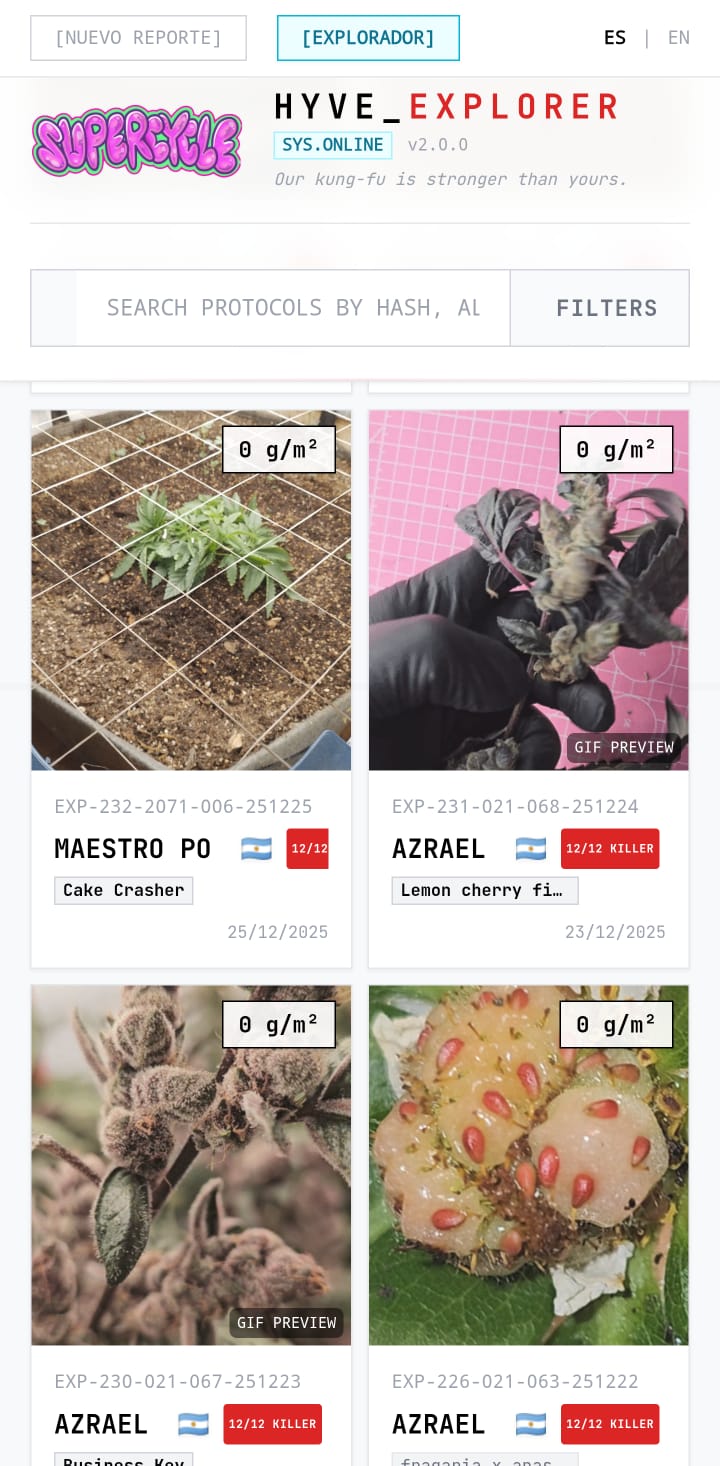
This is an ongoing open investigation. Supercycles do not only change timing. They reshape morphology and flowering architecture.
The full phenotype catalog with visual evidence lives in the Atlas.
Each entry maps to traceable trials.
Everything above this section comes from grows we do not control: different rooms, different operators, different genetics, no paired control arm. Those reports are good enough to decide what to measure. They are not good enough to attribute an effect. So the hypothesis moved into a controlled trial.
Four identical cubicles of 1 x 1 x 2 m. Four cloned genetics, each one repeated in all four cubicles. One 300 W fixture per cubicle, the same substrate, the same irrigation scheme. The only thing that changes between rooms is the length of the cycle.
The working hypothesis is that the endogenous circadian period of Cannabis sativa may sit close to 27 hours. If it does, an external 27 h cycle should behave differently from a 24 h one. This trial does not measure the endogenous period: a result in line with the hypothesis would be indirect evidence, not a measurement.
| ARM | PERIOD T | DISTANCE TO 27 H | ROLE IN THE HYPOTHESIS |
|---|---|---|---|
| 12/12 | 24 h | −3 h | Reference control. |
| 13/13 | 26 h | −1 h | Period close to the proposed value. |
| 13/14 | 27 h | 0 | Central period of the hypothesis. Highest yield predicted. |
| 14/14 | 28 h | +1 h | Contrast, to see the response on both sides of 27 h. |
11.56 h of light per calendar day against 12 h, with 3.7% more darkness. A higher dry weight under less light would point at what the plant does with carbon already fixed, not at how much light it got.
Dry flower weight per plant, cut when the trichomes in a fixed, pre-declared zone stop being mostly clear and the first amber ones appear. Cut dates differ between arms, so calendar days, executed cycles and accumulated light hours are reported as part of the result, not as context.
Published before the first plant was cut, because a limit found afterwards is an excuse:
Circadian resonance in Cannabis sativa. Yield, morphology and resin under four periods with paired clones. Version 0.3, 2 September 2026. Results expected November 2026.
We utilize open source hardware to decouple plant biology from Earth rotation. We view the 24-hour cycle not as a law, but as a variable.
The 24‑hour day is not a law of nature for indoor cultivation it’s an inheritance. A convention that became “normal” because every timer, calendar and workflow assumes it.
"We didn’t just inherit cultivation methods, we inherited time."
Under 12/12, the night is fixed but the day is capped by the 24h container. Supercycles break that container while keeping deep darkness intact.
We’re temporal hackers rewriting the rules of botany. By extending the virtual day to 26h, 28h, or 32h, we decouple light from darkness.
Supercycles allow us to push 14+ hours of light while maintaining 12+ hours of deep darkness. No compromise.
"Time is a parameter, not a prison."
For decades selection took place inside a 24 hour time cage. This was not a biological decision. It was a human convenience.
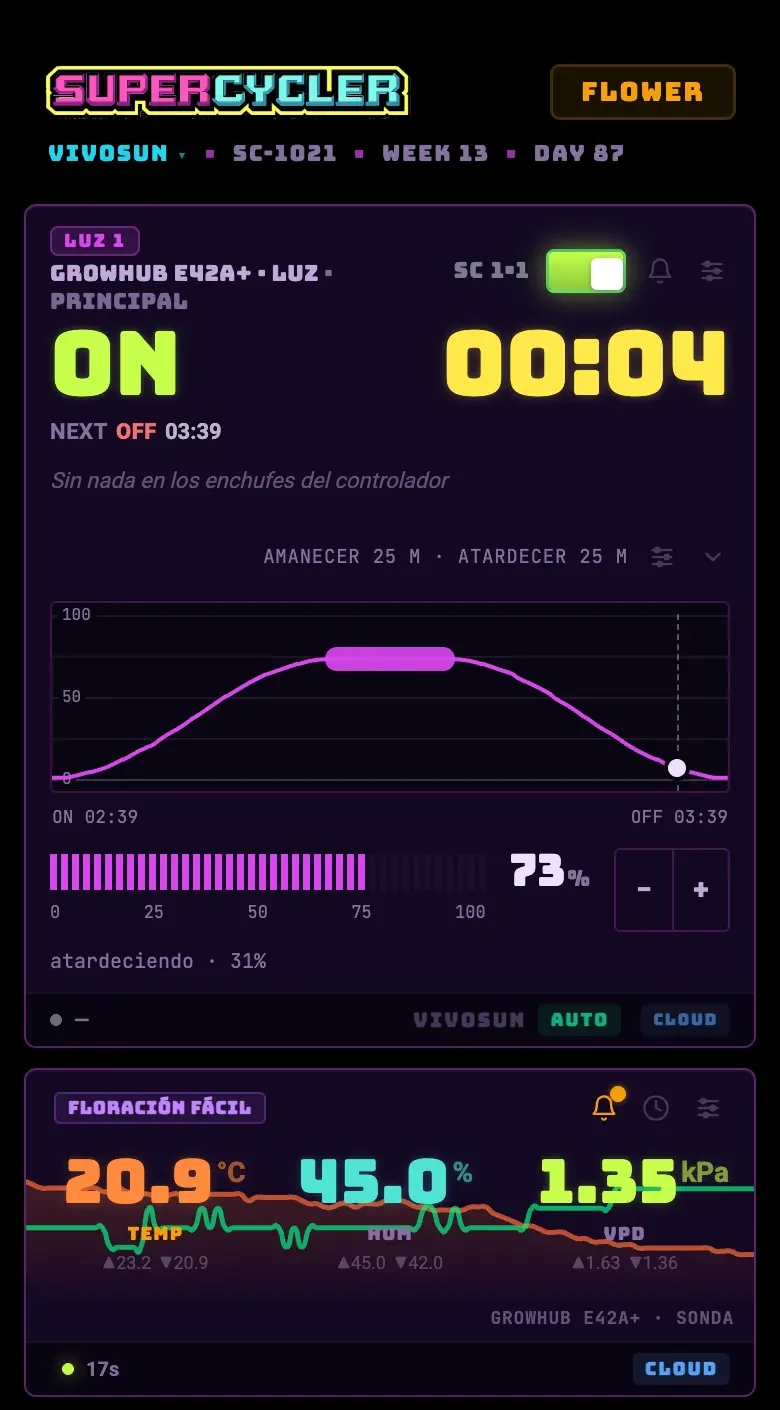
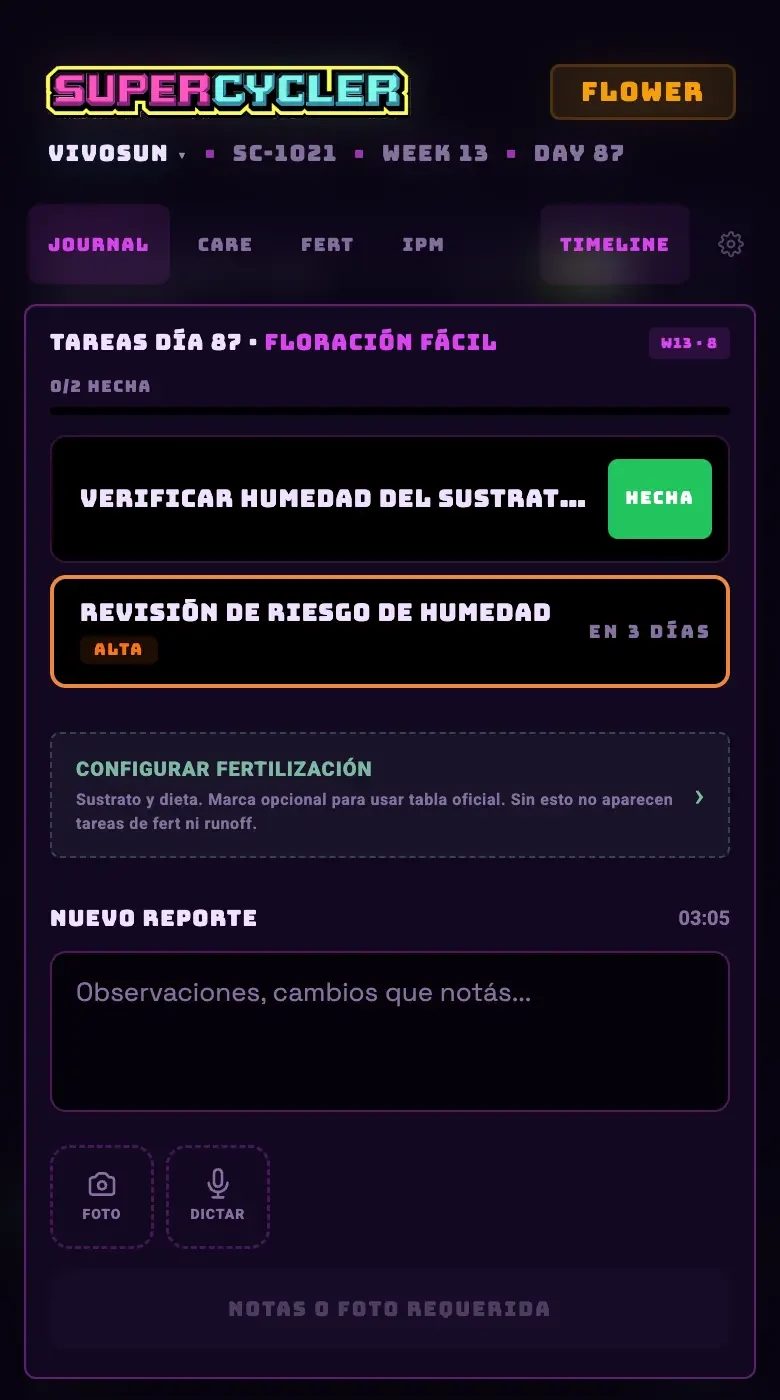
A cycle that does not add up to 24 hours cannot be loaded into an ordinary timer: a timer repeats every 24 h by definition. It needs a controller that computes each transition, executes it, and records the one that actually happened. That is what Supercycler does.
Changing the photoperiod mid-grow re-anchors the clock. The app warns you when the change flips the state of the light at that very instant and asks you to confirm. It is deliberate: doing it without looking is what ruins the most grows.
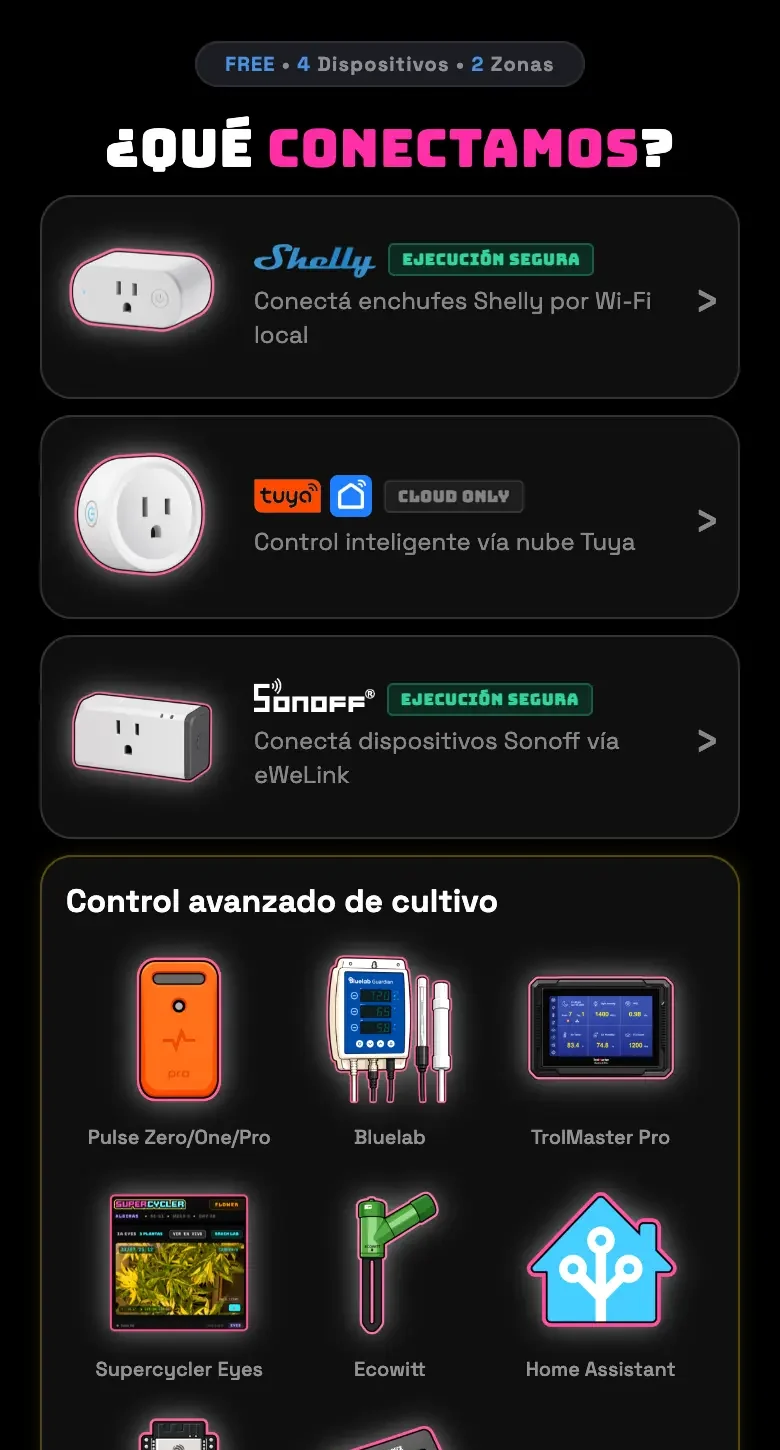
This page used to list these three as "coming soon". They shipped:
Shelly · Sonoff / eWeLink · Tuya · AC Infinity · Mars Hydro · Spider Farmer · VIVOSUN · TrolMaster · Home Assistant · Ecowitt · ESP32
This panel shows the network pulse in real time. Nodes and operators reflect human activity. Genetics and supercycles reflect biological and temporal diversity. Each number maps to traceable reports with evidence.
These counters come from the HYVE_Explorer reports and describe the network, not the controlled trial. The four-period trial of §03.4 is reported separately, with its own pre-registration, its own limits and its own dates.